
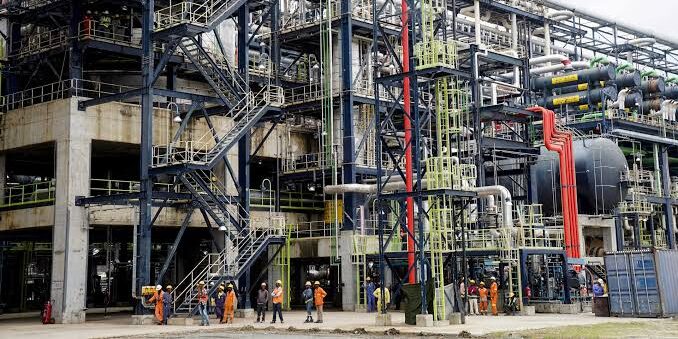
Dangote Refinery Imports 1.46 Billion Litres of Gasoline Blendstock While Maintaining Over 100% Capacity Utilisation
Nigeria’s 650,000-barrel-per-day Dangote Refinery imported an estimated 1.46 billion litres of intermediates and gasoline blendstock over a five-month period from January to May 2026, according to industry data derived from the Nigerian Midstream and Downstream Petroleum Regulatory Authority (NMDPRA) statistics.
The imported products are not sold directly to consumers. Instead, they are used as secondary feedstock, blended with other refinery streams and components to produce Premium Motor Spirit (petrol) that meets required specifications for octane rating, quality, and environmental compliance.
Data reported by The Punch indicate that the refinery maintained strong operational performance during the period, recording an average capacity utilisation rate of 101.25% in May, with daily gasoline production estimated at 44.7 million litres.
The refinery achieved this output by combining crude oil processing with imported intermediates, allowing it to optimise gasoline yields and stabilise production levels.
Despite improved access to crude oil feedstock, the refinery continued importing gasoline blendstock to support output optimisation.
This approach reflects a hybrid processing strategy designed to enhance refining efficiency and maintain consistent product quality while balancing variations in crude supply.
Monthly import figures show 658.31 million litres of gasoline blendstock in January, 306.89 million litres in February, 102.35 million litres in March, 147.37 million litres in April, and 240.59 million litres in May, bringing total imports to approximately 1.46 billion litres over the five-month period.
Crude oil receipts also fluctuated during the same period, rising from 9.53 million barrels in January to 13.11 million barrels in February, peaking at 20.92 million barrels in March, before easing to 18.37 million barrels in April and 17.92 million barrels in May.
The data suggests that while increased crude availability initially reduced reliance on imported blendstock, imports later rose again despite sustained crude intake levels, indicating ongoing optimisation of feedstock sourcing to support refinery performance.
Overall, the figures highlight a dual-feedstock operational model in which both crude oil and imported intermediates are utilised to maximise output efficiency and maintain consistent gasoline production levels.