Angola’s 2,172MW Caculo Cabaça Hydropower Project Nears Completion as Construction Accelerates
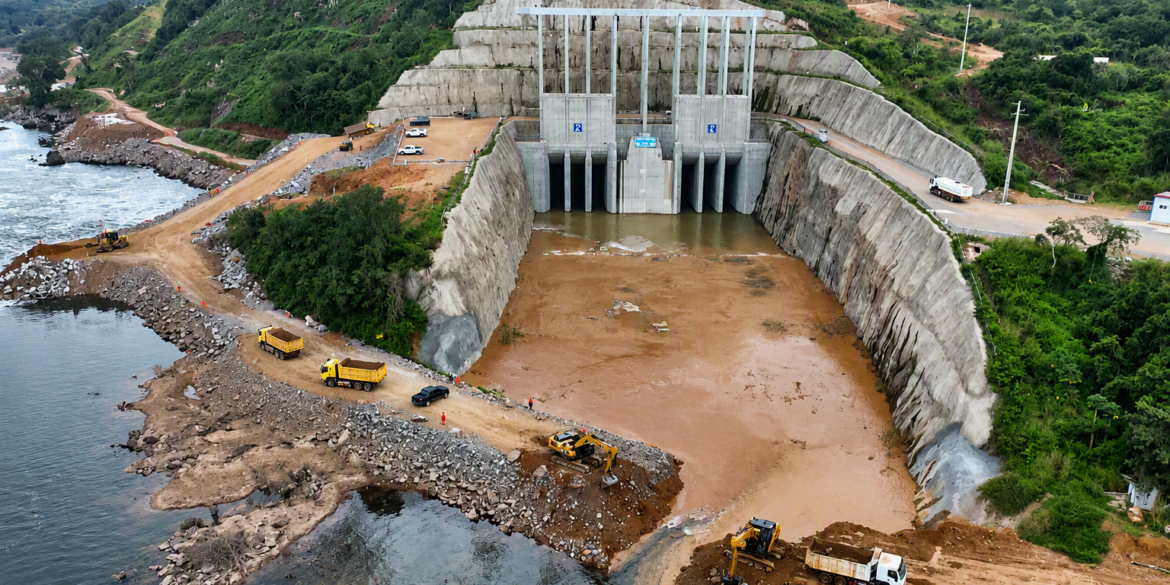
Construction of Angola’s landmark Caculo Cabaça Hydropower Project is advancing rapidly, with work on the main dam structure progressing as the country moves closer to adding 2,172 megawatts of new generation capacity to its power system.
Located on the Kwanza River in Kwanza Norte Province, about 250 kilometres east of Luanda, the $4.5 billion project is being developed by Angola’s Ministry of Energy and Water, with construction led by Chinese contractor China Gezhouba Group Corporation.
Once completed, Caculo Cabaça will become Angola’s largest hydroelectric power station, surpassing the 2,070MW Laúca facility and significantly strengthening the country’s electricity generation capacity.
The project centres on a 103-metre-high concrete dam with a crest stretching 553 metres.
Its reservoir will extend for approximately 16.3 kilometres and cover around 16.6 square kilometres, with a storage capacity of about 440 million cubic metres of water.
The underground powerhouse is another major component of the project. Measuring approximately 221 metres long, 26.5 metres wide and 68 metres high, it will house four 530MW Francis turbines and a 52MW ecological unit. The turbines will be supplied through four concrete-lined headrace tunnels.
Construction has already passed several important milestones. In June 2025, the project completed a major water discharge tunnel, clearing an important stage for subsequent works linked to the powerhouse and generating equipment.
Another key milestone came in May 2024, when President João Lourenço authorised the provisional diversion of the Kwanza River.
The river diversion enabled construction activities on the main dam structure to advance while allowing work to continue on other critical components of the project.
Caculo Cabaça is expected to be completed in October 2026, with commissioning scheduled to follow in 2028.
Once operational, the facility is projected to generate approximately 8,123 gigawatt-hours of electricity annually.
Beyond meeting growing domestic electricity demand, the project is expected to strengthen Angola’s role in regional power markets.
Its output will support electricity exchanges through the Southern African Power Pool, potentially improving regional energy security and cross-border power availability.
The hydropower project is also central to Angola’s broader plans to expand electricity generation. The government is targeting an increase in national installed generation capacity from around 6.4GW to 9GW by 2027, with Caculo Cabaça expected to make a major contribution alongside projects such as the Baynes hydropower development on the Angola-Namibia border.
For Angola, the project represents more than a major infrastructure investment. Increased hydropower capacity could provide the reliable electricity required to support industrialisation, expand access to power and reduce pressure on more carbon-intensive generation sources.
As African economies seek to close electricity access gaps while supporting industrial and economic growth, large-scale hydropower remains an important part of the continent’s energy strategy.
Caculo Cabaça places Angola at the centre of that effort, with the project poised to reshape the country’s power landscape once it enters commercial operation.