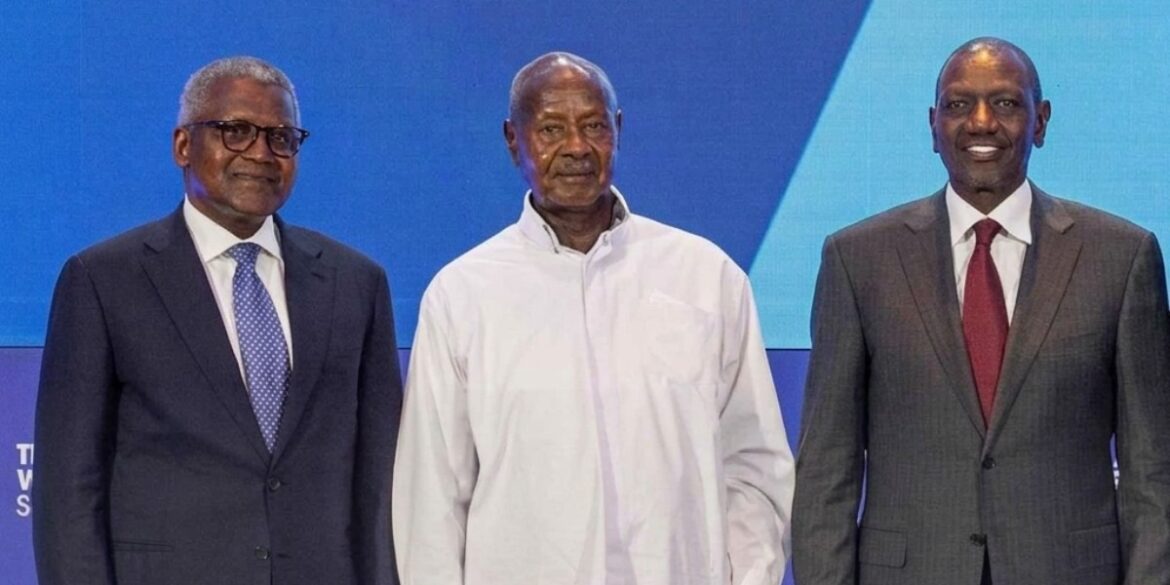
Dangote Proposes 650,000 bpd East Africa Refinery to Boost Regional Industrialisation and Energy Security
Africa’s richest man, Aliko Dangote, has announced plans to expand his refining operations into East Africa with a proposed large-scale refinery similar in size to his flagship facility in Nigeria.
The move comes as African leaders intensify efforts to strengthen industrial self-sufficiency and reduce reliance on imported refined products.
Speaking at the “Africa We Build” summit in Nairobi, Dangote said his group is prepared to construct a 650,000 barrels-per-day refinery in partnership with East African governments, provided there is policy alignment and sustained political support.
He made the proposal alongside Kenyan President William Ruto and Ugandan President Yoweri Museveni.
Dangote stated that the project could be completed within four to five years if conditions are favorable.
The refinery is intended to serve a regional market covering Kenya, Uganda, Tanzania, South Sudan, and the Democratic Republic of Congo, with shared infrastructure designed to reduce costs and improve supply efficiency.
He emphasized that Africa must move away from exporting raw materials while importing finished goods, arguing that this model limits economic growth. “By exporting raw materials and importing finished products, we are impoverishing our population,” he said, calling for accelerated industrialisation and local processing.
The proposal builds on the success of the Dangote Refinery in Nigeria, a $20 billion facility that is already reshaping regional fuel markets.
Dangote noted that the refinery has begun exporting significant volumes of aviation fuel to Europe, highlighting its growing international influence.
Regional leaders at the summit supported the broader vision. President William Ruto stressed that Africa can no longer afford to depend on imported refined products despite having abundant resources, capital potential, and industrial expertise. He noted ongoing discussions around a coordinated regional refining framework.
Ugandan President Yoweri Museveni took a stronger stance, describing the continued export of unprocessed raw materials as economically damaging and arguing that African economies lose substantial value by failing to industrialize.
Dangote also called for improved intra-African mobility, criticizing restrictive visa regimes that hinder trade and business movement across the continent.
He argued that freer movement of people would strengthen integration and economic cooperation.
Beyond East Africa, Dangote revealed plans to invest up to $40 billion by 2030 across refining, petrochemicals, fertiliser production, and manufacturing.
He stressed that consistent and predictable government policy will be essential to attracting long-term investment.
The announcement comes amid a shifting energy landscape across Africa. Nigeria–South Africa trade has recently grown significantly, driven largely by demand for crude oil and refined products, underscoring the increasing importance of intra-African energy flows.
In Nigeria, the Dangote Refinery has become a key supplier to the domestic aviation sector, reportedly meeting over 95% of national jet fuel demand. However, industry stakeholders continue to debate pricing dynamics and distribution efficiency within the downstream market.
Analysts note that the refinery’s rising export volumes reflect Nigeria’s growing role in global fuel markets, while also strengthening domestic energy security.
At the same time, officials estimate that African economies collectively lose tens of billions of dollars annually by exporting unprocessed raw materials instead of adding value locally.
If implemented, the East African refinery would represent one of the largest cross-border industrial investments in Africa, with far-reaching implications for energy security, trade integration, and regional industrial development.