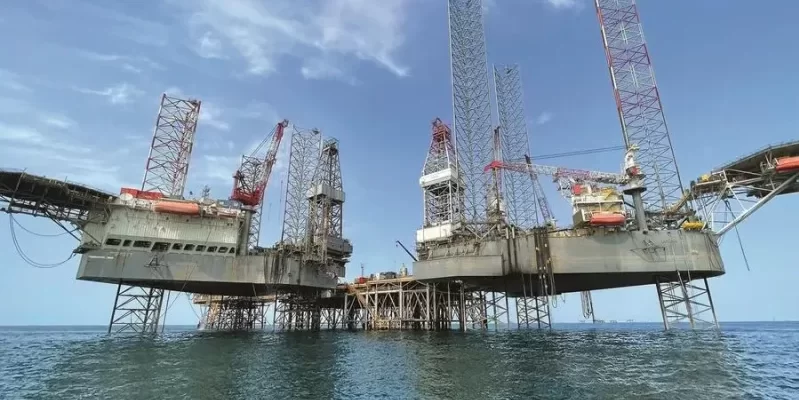
Egypt’s Gulf of Suez Oil Discovery to Boost Crude Production by 3,000 BPD
Egypt, North Africa’s third-largest oil producer, has announced a new offshore oil discovery in the Gulf of Suez, expected to add around 3,000 barrels per day (bpd) to the country’s crude oil production.
The well, named Northeast Ramadan Crystal (NER-1X), is located in the North-East Ramadan Concession and was drilled by the Gulf of Suez Petroleum Company (GUPCO), a joint venture between the Egyptian General Petroleum Corporation (EGPC) and the UAE’s Dragon Oil.
Early production is already underway using the existing Al-Fanar platform, minimizing the need for new offshore infrastructure and reducing development costs.
The discovery was aided by Ocean Bottom Node (OBN) seismic technology, which allowed geologists to identify previously inaccessible formations beneath the seabed.
According to the Ministry of Petroleum and Mineral Resources, this technology has improved exploration efficiency in the Gulf of Suez basin and accelerated development timelines.
Egypt produces crude oil and natural gas from multiple onshore and offshore fields, with major production concentrated in the Gulf of Suez, Western Desert, and Nile Delta. Current crude output stands at approximately 540,000 bpd.
Despite this, the country still imports crude and refined petroleum products, including diesel, gasoline, and jet fuel, as domestic refineries cannot fully meet local demand.
This Gulf of Suez discovery marks Egypt’s third major find since June, following two recent exploration successes in the Western Desert.
In the Abu Sennan brownfield, EGPC recorded a second significant find within three months, supported by artificial intelligence tools applied to reservoir and seismic analysis, highlighting opportunities to extract additional resources from mature fields.
Since July 2024, Egypt’s petroleum sector has registered 75 new oil and gas discoveries and brought 383 wells into production.
Natural gas output has reached approximately 4.2 billion cubic feet per day (bcf/d), while crude oil production remains steady at 540,000 bpd.
Petroleum and Mineral Resources Minister Karim Badawi stated that Egypt plans to invest $1.2 billion to drill 110 exploratory wells.
This effort forms part of a broader $7.2 billion program to drill 586 wells by 2030, underscoring the country’s commitment to expanding upstream capacity and strengthening its energy sector.