Bharat Petroleum Strengthens Upstream Presence with Mozambique LNG Project Revival
Bharat Petroleum Corp. Ltd (BPCL) has secured the rights to market liquefied natural gas (LNG) from Mozambique’s long-delayed Offshore Area 1 project, in which it holds a 10% stake, as full-scale development is set to resume following improved security conditions.
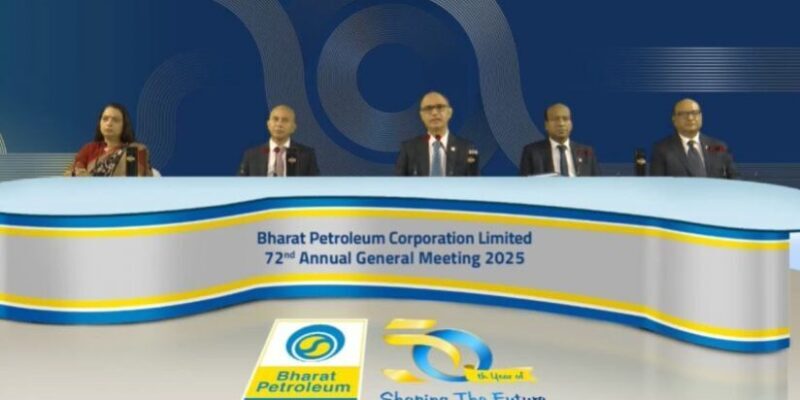
Addressing BPCL’s annual general meeting, Chairman and Managing Director Sanjay Khanna said the project, jointly owned by three Indian public sector undertakings (PSUs) with a combined 30% stake, will enhance BPCL’s upstream portfolio.
“While security concerns had delayed the project, conditions have improved, and full-scale development is expected to resume soon,” Khanna stated.
“Once operational, the two-train LNG project will strengthen our upstream presence and support the energy transition. We have already secured LNG marketing rights corresponding to our 10% participating interest.”
The chairman described the Mozambique project as a world-class gas asset, with nearly 70 trillion cubic feet of recoverable resources.
Project ownership is divided as follows: ONGC Videsh Ltd (16%), BPRL Ventures Mozambique BV (10%), and Oil India Ltd (4%), while Total E&P Mozambique Area 1 Limitada, a subsidiary of TotalEnergies, holds 26.5% and serves as the operator.
Operations at the Palma-based project were suspended in April 2021 following attacks by Islamic State-affiliated terrorists.
Khanna also highlighted BPCL’s upstream progress in other regions:
Brazil: The BM-SEAL-11 block is moving into the tendering stage for a Floating Production Storage & Offloading (FPSO) vessel and other long-lead items.
Indonesia: The Nunukan asset has received regulatory approval for its Plan of Development (POD), paving the way for project execution.
BPCL entered the upstream sector in 2003 to enhance crude supply security, hedge price risks, and develop into a vertically integrated oil company. Its subsidiary, BPRL, was established in 2006 for exploration and production activities.
BPRL holds participating interests in 15 blocks—eight in India and seven overseas—including equity stakes in Russian entities with licenses for four producing blocks.
International stakes in Brazil, Mozambique, Indonesia, UAE, and Russia are held through wholly-owned subsidiaries or joint ventures in the Netherlands and Singapore.
Khanna noted that FY25 has been marked by heightened volatility due to geopolitical conflicts, protectionism, and shifting trade policies, including tariffs imposed by major economies.
“These disruptions have tested global market resilience, yet cautious optimism remains,” he said. “Global growth projections for 2025 have been revised upward—from 2.8% to 3.0%—reflecting stronger-than-expected performance in large economies, a rebound in services trade, and sustained fiscal support in select regions.”
On the global oil sector, Khanna observed structural shifts reshaping demand and supply as the world transitions toward cleaner energy and diversified fuels.
“By 2030, global oil demand is expected to grow by 2.5 million barrels per day, plateauing at roughly 105.5 million barrels per day by decade-end,” he said.
“As the transport and power sectors diversify, the petrochemical industry will become the primary driver of oil demand growth. Meanwhile, the unwinding of production cuts is resetting global supply trajectories through 2030.”
On BPCL’s diversification strategy, Khanna emphasized Project Aspire, which aims to strengthen refining, marketing, and upstream operations while advancing into petrochemicals, renewables, green hydrogen, biofuels, and gas.
The company plans a total capital expenditure of ₹1.70 trillion under this initiative.
He also highlighted that recent amendments to the Oilfields (Regulation and Development) Act would help BPCL unlock new acreages and enhance recovery from existing fields, creating opportunities for selective, high-potential investments in India’s sedimentary basins through BPRL.