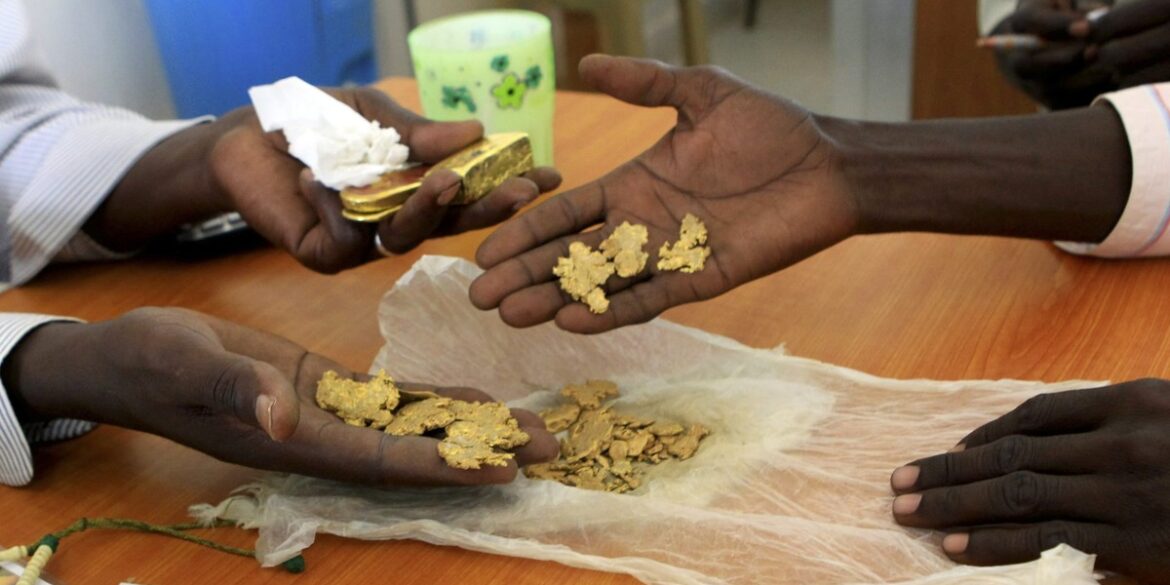
Sudan Relies on Gold Revenues as War Enters Fourth Year, Smuggling and Investor Shifts Reshape Sector
Sudan’s gold industry is emerging as the government’s primary source of revenue as the country’s civil war enters its fourth year.
Strong performance from artisanal mining and renewed efforts to attract foreign investment are reshaping the sector’s role in the national economy.
The Sudanese Mineral Resources Company (SMRC) reported that revenues from artisanal mining reached 113% of first-quarter targets in 2026, while overall gold production achieved 89% of planned output.
These figures highlight gold’s growing importance as a financial lifeline for Sudan, where conflict between the Sudanese Armed Forces and the Rapid Support Forces (RSF) has severely disrupted agriculture, trade, and other revenue streams.
Since fighting began in 2023, control over gold mines and trade routes has become a critical source of funding for both sides, placing the metal at the center of Sudan’s war economy. Gold now accounts for more than 58% of the country’s export value, making it its largest source of foreign exchange.
In 2023, Sudan’s total exports were valued at $5.09 billion, with gold contributing $1.03 billion second only to crude oil at $1.13 billion.
Finance Minister Gibril Ibrahim stated that Sudan produced around 70 tonnes of gold in 2025, exceeding its national target by 13%.
However, official exports remained below 20 tonnes, underscoring the scale of smuggling and informal trade.
Central bank data indicates that only 14.7 tonnes were exported through official channels, generating approximately $1.536 billion.
Artisanal Mining Dominates Output
Artisanal and small-scale mining accounts for roughly 80% of Sudan’s total gold production, particularly in River Nile, Northern, and Red Sea states. The formal corporate sector contributes the remaining 20%.
While the sector provides livelihoods for hundreds of thousands of people, it largely operates outside regulatory frameworks, limiting government revenue collection and weakening export oversight.
SMRC General Manager Mohamed Taher Omer said improved field operations and stronger revenue systems contributed to the sector’s solid first-quarter performance. He also noted progress in environmental standards and digital governance.
Planning Director Al-Sadiq Al-Haj Taha added that surplus revenues have been reinvested into health, water, and education projects in mining communities.
Foreign Investment and Conflict Dynamics
Despite instability, Sudan’s formal mining sector continues to attract international interest from countries including Russia, China, Canada, and Gulf states.
However, the ongoing conflict has also led to investor caution and withdrawals, particularly among U.S.-linked firms.
Territorial control of gold resources remains divided: the Sudanese Armed Forces dominate most eastern deposits, while the RSF controls key central and southwestern mining regions. This fragmentation has made access to gold reserves a strategic objective within the conflict.
Russia-linked operators, including entities previously associated with the Wagner network such as Meroe Gold, have drawn scrutiny over alleged involvement in unofficial gold exports and conflict financing.
In contrast, Perseus Mining exited the market in March 2026, selling its 70% stake in the Meyas Sand Gold Project for $260 million, citing the prolonged conflict as the primary reason.
Meanwhile, several Chinese-backed firms continue operations despite the instability.
Trade Shifts and Gulf Market Dynamics
The United Arab Emirates was Sudan’s largest trading partner in 2023, importing $1.09 billion worth of goods almost entirely gold and accounting for more than 99% of officially recorded exports.
However, tensions between Khartoum and Abu Dhabi have risen following accusations that the UAE supports the RSF. This has prompted Sudan to seek alternative buyers.
Saudi Arabia has signaled readiness to begin purchasing Sudanese gold, offering a potential alternative market and strengthening Sudan’s negotiating position in the region.
Smuggling Continues to Undermine Revenues
Despite strong production figures, smuggling remains a major challenge. A 2024 study by SWISSAID estimated that between 321 and 474 tonnes of African gold are smuggled annually, valued at $24 billion to $35 billion. Much of this gold passes through Gulf markets before being re-exported.
The scale of illicit trade continues to erode Sudan’s official revenues, intensifying pressure on authorities to strengthen export controls, improve traceability, and diversify trading partners.
As the conflict persists, Sudan’s gold sector is likely to remain central to both its economic survival and the broader dynamics of the war economy.