Dangote Refinery Reshapes West Africa’s Fuel Market as Imports Plunge and Trade Routes Shift
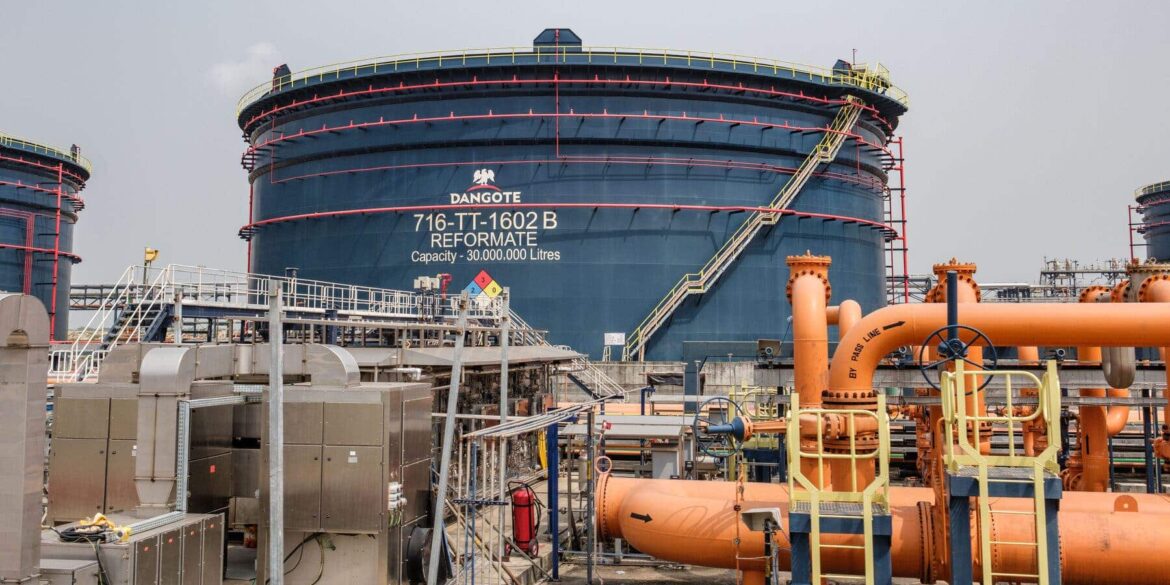
The rapid ramp-up of production at the Dangote Petroleum Refinery is transforming fuel trade across West Africa, significantly reducing the region’s reliance on imported refined petroleum products.
According to recent industry data cited by S&P Global, West Africa’s imports of clean refined petroleum products fell sharply to 765,000 barrels per day (bpd) in May, down from approximately 997,000 bpd in April.
The decline of nearly 23% within a single month highlights the speed at which regional fuel supply dynamics are changing.
Shipping data firm BIMCO attributed the downturn largely to increased output from Nigeria’s Dangote Refinery, which has a processing capacity of 650,000 barrels per day.
As domestic refining capacity expands, Nigeria and neighboring countries are requiring fewer imported fuel volumes, triggering a major shift in regional trade flows and tanker activity.
BIMCO estimates that overall fuel imports into West Africa declined by as much as 44% during the period, leading to a substantial drop in shipping demand measured in tonne-miles.
“LR1 and LR2 product tankers recorded the largest declines, down 88% and 78% respectively, and together accounted for 55% of the total tonne-mile loss,” S&P Global quoted BIMCO as saying.
The impact on medium-range (MR) product tankers was less severe. According to BIMCO, MR tanker tonne-miles declined by around 4% between April and May despite significant reductions in imports from major supply regions.
“A 34-fold increase in volumes from the Americas largely offset the decline, limiting the overall loss,” BIMCO noted.
Historically, the Rotterdam-to-Lagos route has been one of the most important corridors for MR tanker traffic.
However, that trade lane has weakened considerably as Nigeria increases local refining output and reduces its dependence on fuel imports from Europe.
Analysts also project that Nigerian imports of refined petroleum products could fall by 39% year-on-year by mid-2025, further reshaping Atlantic Basin fuel trade.
“Data indicated a 39% year-on-year drop in Nigerian clean petroleum product imports by mid-2025, essentially removing a massive source of employment for MR tankers in the Atlantic,” analysts from S&P Global’s Commodities at Sea (CAS) platform said.
The reduction in import demand has significantly lowered the need for Atlantic shipping capacity, particularly among MR tankers that previously served the Nigerian market.
According to S&P Global Commodity Insights, freight rates on the UK Continent-to-West Africa route have also weakened, reflecting declining demand for long-haul gasoline shipments into the region.
Meanwhile, the Dangote Refinery is emerging as a major exporter of refined petroleum products.
The facility reportedly exported a record 372,000 barrels per day of refined products in April, underscoring its growing influence on global fuel markets and international trade flows.
The refinery’s expansion is increasingly positioning Nigeria as a regional refining hub, with far-reaching implications for fuel imports, shipping patterns, and energy security across West Africa.