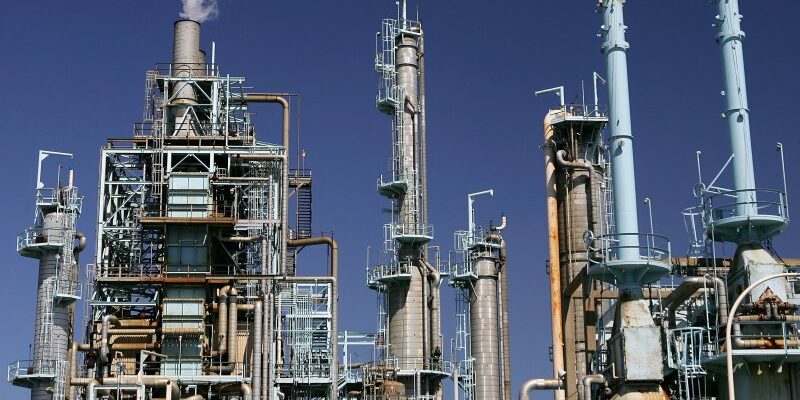
Ghana to Expand Tema Oil Refinery Capacity to 45,000 bpd to Reduce Fuel Imports
Ghana is taking steps to strengthen its domestic fuel supply as the Tema Oil Refinery (TOR) advances plans to expand crude processing capacity, a move that could modestly increase refining output across West Africa.
The state-owned refinery plans to raise production from about 28,000 barrels per day (bpd) to 45,000 bpd, representing a 61% increase.
The expansion will be achieved through the installation of a new fuel processing unit, known as F-61, which will operate alongside the existing facility.
Both processing units will be linked to the refinery’s crude distillation system, allowing TOR to handle larger volumes of crude oil and produce greater quantities of refined petroleum products.
TOR’s Corporate Affairs Officer, Godwin Mahama Ayaba, said the refinery currently operates at a nameplate capacity of 28,000 barrels per stream day.
Integrating the F-61 unit will raise total capacity to 45,000 barrels per stream day, working alongside the existing F1 unit connected to the crude distillation system. Refining operations are expected to continue during the integration process.
Once completed, the upgrade could help reduce Ghana’s dependence on imported refined fuels and strengthen the country’s role in the region’s evolving refining market.
West Africa has historically relied heavily on imported petroleum products due to limited local refining capacity.
However, supply dynamics are beginning to shift following the launch of the Dangote Petroleum Refinery in Nigeria, Africa’s largest refinery with a capacity of 650,000 barrels per day.
Although significantly smaller than the Dangote facility, the planned expansion at TOR could still support fuel supply stability across the sub-region, particularly for neighboring countries that rely on imports through Ghana’s ports.
The project forms part of Ghana’s broader efforts in recent years to strengthen development across its natural resource sectors.
The Tema Oil Refinery is Ghana’s only refinery and has a total installed capacity of about 45,000 barrels per day, supplying roughly 60% of the country’s fuel demand.
The refinery sources crude mainly from Nigeria and other African producers, including Equatorial Guinea, Cameroon, Gabon, and Angola.
Under the Ghana Infrastructure Plan 2018–2047, authorities intend to further expand TOR’s capacity to 60,000 bpd.
The government is also considering the construction of a new refinery in the Western Region to process crude from Ghana’s offshore oil fields.
Ghana also remains a major player in the mining sector. The country is Africa’s leading gold producer, with annual output exceeding 4 million ounces, according to the Ghana Chamber of Mines.
The industry continues to attract strong international investment and represents a key source of government revenue.
In the oil sector, production from the Jubilee Oil Field, TEN Oil Field, and Sankofa Oil Field has helped strengthen Ghana’s position as a notable crude producer in West Africa.