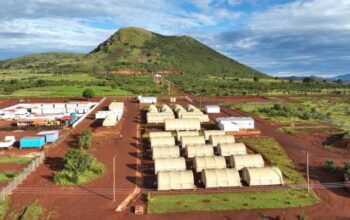

Angola’s Lobito Refinery to Boost Energy Independence and Drive Benguela’s Economic Transformation
The Governor of Benguela Province, Manuel Nunes Júnior, has described the Lobito Refinery as a transformative project that will elevate Angola to a new level of energy autonomy while offering tangible hope and opportunity for the region’s youth.
Speaking on Tuesday during a visit by President João Lourenço to the refinery’s construction site, Nunes Júnior said the project represents an anchor investment and a catalyst for the integrated development of Benguela Province.
He highlighted its expected positive impact across multiple sectors, including agro-industry, fisheries, services, technical and professional training, and the stimulation of local entrepreneurship.
“The youth of Benguela see this project as a concrete sign of hope and a better future, and as proof that the Executive’s policies are creating real and lasting opportunities,” the governor said.
He described the refinery as an investment of historic scale and high strategic value, not only for Angola but for the African continent.
According to Nunes Júnior, the project reflects a clear and decisive government policy that, once completed, will significantly reduce Angola’s dependence on imported fuels and lay the foundation for more sustainable, inclusive, and long-term economic growth.
For Benguela Province, and the city of Lobito in particular, the refinery is expected to drive profound structural change.
The governor noted that it will create jobs, increase household incomes, invigorate the local business environment, and strengthen the province’s contribution to national economic growth.
He also underscored Benguela’s strategic importance as home to the Lobito Corridor, one of Africa’s most critical logistics platforms linking the Atlantic Ocean to landlocked countries in Southern and Central Africa.
The integration of the refinery with the Port of Lobito and the Benguela Railway, he said, will create a powerful industrial, logistical, and commercial axis, positioning Angola as a regional energy and logistics hub.
Nunes Júnior added that under President Lourenço’s leadership, the Lobito Corridor has evolved beyond a transport route into a geostrategic instrument for regional integration, international investment attraction, and economic projection.
The governor reaffirmed the provincial government’s full commitment to working closely with the central Executive to ensure the success of the refinery and to maximise its benefits for the Angolan people.
The Lobito Refinery, with an estimated investment exceeding $6 billion, is designed to process up to 200,000 barrels of crude oil per day and is scheduled for completion in 2029.